
Recipient of the 2002 Alice P. Kenney Award for research and writing on the food customs and diet of the Dutch settlers in New Netherland
Hudson Valley food; Dutch colonial food history; recipes; books; unusual regional products
-crop-u751.jpg?crc=35958410)
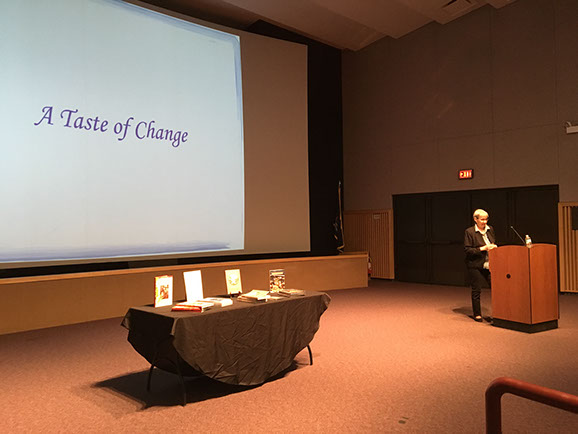
Recently I gave a talk on "Art in Food and Food in Art" at the beautiful Albert Wisner Public Library in Warwick, NY.
Photographer Billy Newman, an old friend, came to the talk and took this photo.
ANNOUNCING SIX Illustrated Lectures
1) New: CHOCOLATE!
The Hudson Valley’s trading and manufacturing history of what is now our favorite confection, but started as an invigorating and nourishing drink will be discussed in a PP presentation by Culinary Historian Peter G. Rose. She will describe the early trade by the Valley’s Dutch settlers in the 17thcentury and the subsequent manufacturing developments of chocolate through the 18thcentury into the late 19thcentury. She will end with some useful facts on working with today’s chocolate. A recipe sheet will be available as a hand-out.
(Ms. Rose was part of a group of more than 100 scholars, who investigated the history of chocolate in America, sponsored by the Historic Division of Mars, Inc., which culminated in a book Chocolate: History, Culture & Heritage(Wiley, 2009)).
This talk lends itself to co-sponsorship with local chocolate sources.
2) A Taste of Change
Hand-written cookbooks as documents of social and family history
Cookbooks and scrapbooks tell us a lot more than just how a dish is made. What recipes are included often give us an indication of the family’s ethnicity and how that ethnicity was retained over generations through the continuation of customs and celebrations. Using her knowledge of Dutch customs and food history, food historian Peter G. Rose will discuss examples of such recipe/scrap-books, dating as far back as the late 17th century and ranging to the 20th century that contain Dutch recipes. They show the continued identification with the forebears, but also the gradual assimilation. Photographs of pages in cookbooks as well as 17th-century paintings will illustrate the talk. The audience is encouraged to bring old family cookbooks/recipe boxes and a discussion of the importance of saving such items is part of the program.
3) From Garden to Table
This PowerPoint presentation is based on a 17th-century Dutch gardening- and cookbook, which features a calendar for gardening activities and a cookbook that explains how to use the fruits and vegetables grown in the garden to best advantage. The 400-year old book with its contemporary theme helps in understanding the kitchen gardens of the early Dutch settlers of the Hudson Valley and gives insight in our colonial diet. Illustrations include etchings from the book; works by the Dutch masters such as kitchen scenes by Joachim Beuckelaer; market stalls by Quiringh van Brekelenkam and Pieter Cornelis van Rijck; as well as sumptuous still lifes by Abraham van Beyeren.
(Note: many organizations combine forces with their local garden clubs in sponsoring this lecture
4) Art in Food and Food in Art
A lusciously illustrated slide or PowerPoint talk on food and drink seen in the art of the17th century Dutch Masters and their relevance to the American kitchen today: The talk explores the foodways brought to America by the Dutch more than three centuries ago and how these foods were changed and adapted under the new circumstances. This lecture attracts a varied audience of art as well as food lovers.
Using slides of some 40 paintings by Jan Steen, Adriaen van Ostade, Jan Davidsz. De Heem, Pieter Claesz, Harmen van Steenwijck and many others, the lecture will demonstrate how these art works give an insight in 17th century food practices and shed new light on the colonial diet..
5) The Influence of the Dutch on the American Kitchen
Explores the food ways brought to America by the Dutch more than three centuries ago and the way these foods were adapted to the new circumstances. Images of seventeenth-century Dutch art works depicting various foodstuffs are part of the lecture.
6) Saint Nicholas: the Saint who became Santa:
Food historian Peter G. Rose delves into the early history of the life of the Saint; explains the various changes in his veneration; and relates how he was brought to America by the Dutch in the seventeenth century and, again, transformed to Santa in the 19th century. The talk encompasses such subjects as literature, religion, the fine arts, and Dutch food ways to describe the extraordinary story of his generosity that had a lasting impact on us all.
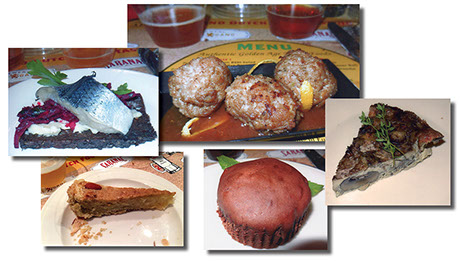
SPECIAL EVENT at the Munson Williams Proctor Arts Institute in connection with their exhibit "The Golden Age of European Painting:"
Historical recipes from the Golden Age paired with craft beers from Brewery Ommegang, Cooperstown, NY and Saranac Brewery, Utica, NY
Author/Food Historian Peter G. Rose created the 5-course menu of historically appropriate dishes, presented as small plates, each accompanied by 2 beers for tasting.
Catering by Leaf, Loaf & Ladle at RCL, Debra Richardson.
LECTURES
LECTURES / TALKS
Culinary historian Peter G. Rose is the author of 10 books on the Dutch influence in America and Hudson Valley food. She has lectured on a variety of topics related to Dutch and Dutch-American culinary history at: The National Gallery; The Smithsonian Institute; Harvard University's Fogg Museum; New York University; the New York State Library; the New York Historical Society; as well as more than a hundred other historical societies and libraries in New York State and various museums in the Netherlands, including the Mauritshuis National Picture Gallery in The Hague.
PLEASE NOTE:
Peter Rose, who turned 86 in 2025 and has had various health issues, has decided - with great regret - that it is time for her to retire from giving in-person lectures. She will remain available for talks on zoom, projects that do not require her presence and for questions on the subject of the history of the Dutch in America, their culinary history and influence on the American kitchen.
Please contact Peter G. Rose - pgrose2006@yahoo.com.
If you would like further information, please email me.pgrose2006@yahoo.com
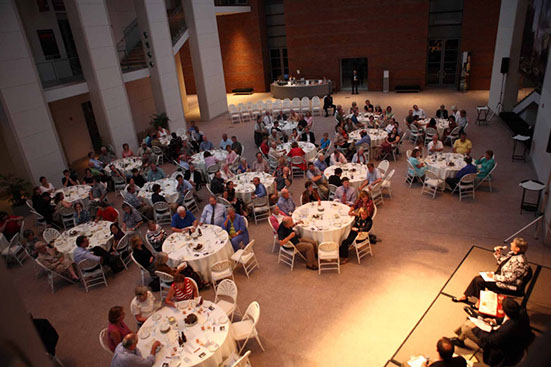
It was a pleasure to be part of a panel on Dutch food, beer and culture
at the Peabody Essex Museum in Salem, MA. in August 2009.